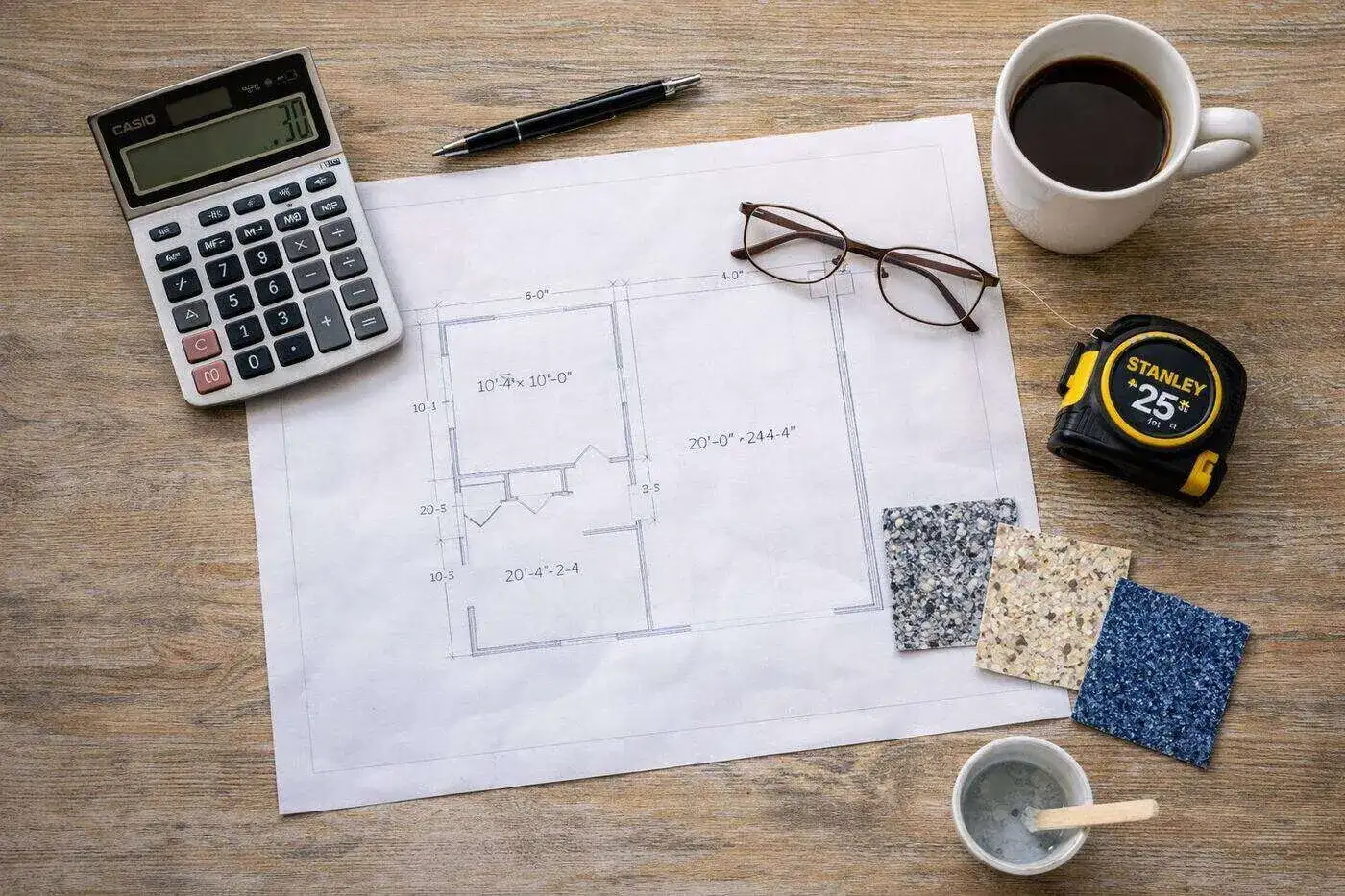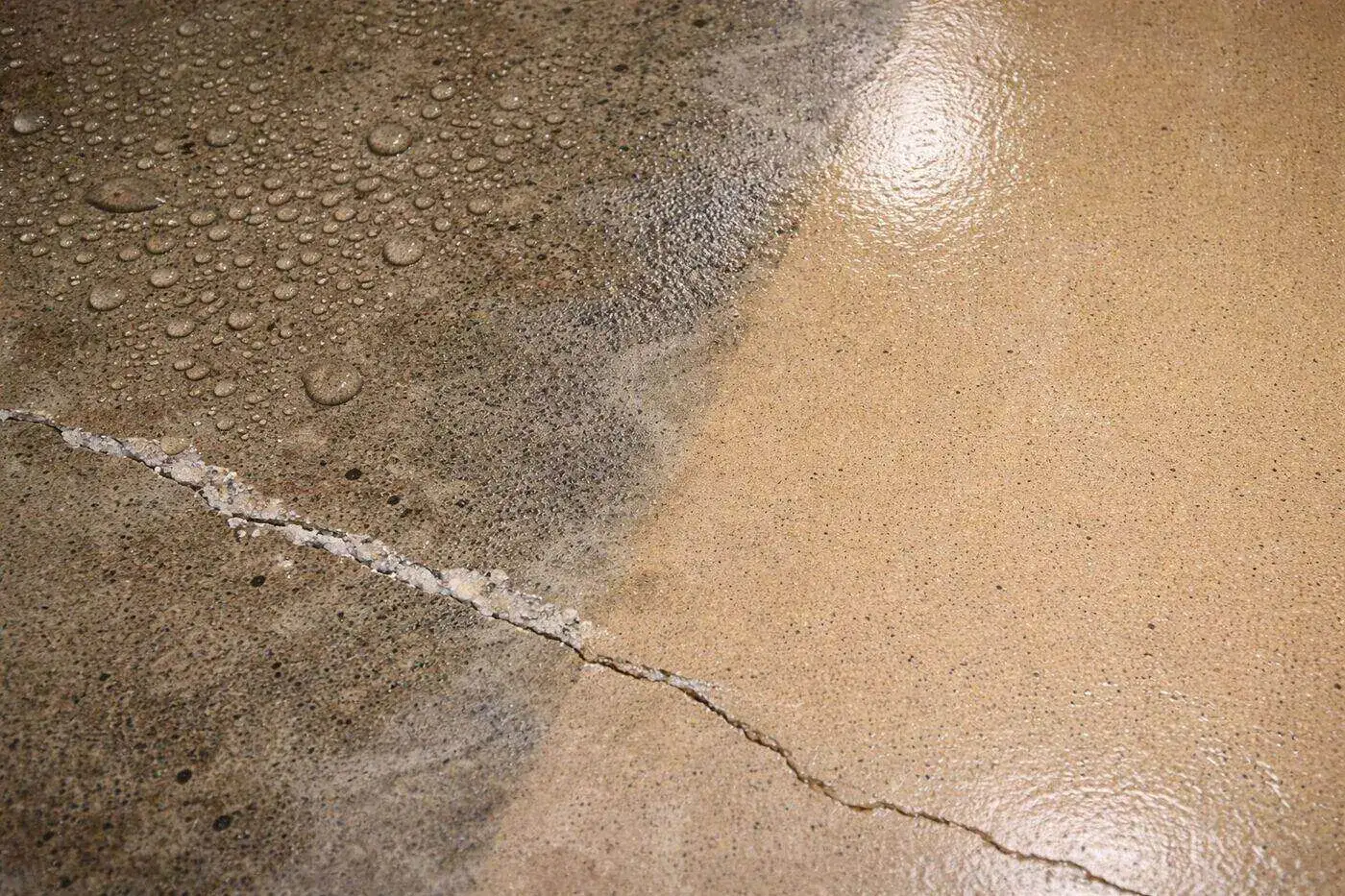
If you live in the capital region, you already know that Gulf South humidity is a year-round companion, not a summer visitor. Baton Rouge sits in the elbow of the Mississippi River, low and flat between the river to the west and the Atchafalaya Basin to the southwest, and that geography keeps the air heavy almost every month of the year. The city averages roughly 74% relative humidity, with morning readings that routinely climb past 90% from March through October. Walk out the door on an August morning along Highland Road or near the LSU lakes and the air feels like a warm, wet towel. Most people treat that humidity as a nuisance that fogs the windshield or wilts a fresh haircut. But if you are weighing an epoxy floor for your home, garage, or shop, humidity is the one environmental factor that decides whether the coating bonds, cures, and lasts for decades or starts lifting within months.
This is exactly why choosing a garage epoxy flooring installer who actually understands the Baton Rouge environment matters so much. A protocol that works fine in an arid Hill Country garage out west or a high-desert slab does not automatically translate to a slab poured on river-bottom clay a few miles from the Mississippi. The way the slab is tested, the primer system chosen, and the time of year the job is scheduled all have to account for our specific conditions. The same is true for residential epoxy flooring across East Baton Rouge, Ascension, and Livingston parishes, whether you are coating a kitchen, a laundry room, a back patio, or a converted carport. Humidity touches every install in this region, regardless of the room or the square footage.
This guide breaks down exactly how the Gulf South climate works against an epoxy floor at every stage, from the ground moisture pushing up through your slab to the wet air sitting on the coating as it cures. We cover the chemistry, the conditions that are specific to the river parishes, and what a proper, humidity-aware installation looks like in a place this damp. If you are collecting quotes for an epoxy floor anywhere from Mid City to Prairieville, this is what you want to understand before you sign a contract.
Why Humidity Matters for Epoxy Installation
Epoxy is a thermosetting polymer, which means it cures through a chemical reaction between a resin and a hardener. Unlike paint, which dries by evaporation (the water or solvent leaves, and the solid coating remains), epoxy undergoes an exothermic crosslinking reaction. The resin and hardener molecules bond together to form an extremely dense, rigid polymer network. This is what gives epoxy its hardness, chemical resistance, and durability. But this chemical reaction is highly sensitive to environmental conditions, and humidity is one of the biggest variables.
When ambient humidity climbs above 80%, a phenomenon called amine blush becomes a serious risk. Amine blush occurs when the amine-based hardener in the epoxy reacts with moisture and carbon dioxide in the surrounding air instead of fully crosslinking with the resin. The result is a waxy, greasy film that forms on the surface of the curing epoxy. You can sometimes see it as a whitish or cloudy haze. Other times it is nearly invisible but present when you run your hand across the surface and feel a slick, oily residue.
The problem with amine blush is not cosmetic. It destroys inter-coat adhesion. When you apply a topcoat or a second layer of epoxy over a blushed surface, the new material bonds to the waxy film, not to the actual epoxy below. This means the topcoat is essentially floating on a layer of contamination. Over time, often within just a few months, the topcoat will peel, delaminate, or flake off in sheets. It is one of the most common reasons epoxy floors fail prematurely, and it is almost entirely preventable with proper environmental controls.
In Baton Rouge, where the air sits above 80% relative humidity through most of the calendar, amine blush is a live risk for the majority of the year rather than a rare bad-weather event. Coatings chemistry tells us the blushing reaction accelerates sharply as moisture climbs, so the difference between a dry Mountain West install and a humid Gulf South one is not a small adjustment. It is the whole ballgame. Even modest swings in ambient humidity during the critical 24-to-72-hour cure window can change the outcome of the floor. Temperature compounds it. When a slab cools toward the dew point overnight, a thin film of condensation forms on the surface of the curing epoxy, and in a climate where the dew point regularly sits in the 70s for weeks at a time, that condensation risk is part of nearly every Baton Rouge job rather than an occasional one. This is the core reason an out-of-region crew, or a homeowner following a YouTube tutorial filmed in Arizona, so often ends up with a peeling floor here.
Moisture in the Slab — Baton Rouge's Hidden Problem
Ambient humidity is only half the equation. The other half is the moisture already inside your concrete slab, and this is where Baton Rouge properties face a challenge that most other markets in the country simply do not have to deal with at the same scale.
Slab-on-grade construction is the default building method across Baton Rouge and the river parishes, and the reason is the ground itself. The high water table and soft, expansive clays that the Mississippi laid down over centuries make basements impractical and rare here, so concrete is poured directly on grade, sometimes over a gravel sub-base and a vapor barrier, often over neither. That leaves nothing but a few inches of concrete between your finished floor and soil that stays damp far more of the year than the ground in drier parts of the country.
The capital region's heavy alluvial clay drains slowly and holds water. After one of our regular soaking rains, or a stretch of Gulf storms rolling up from the coast, that clay swells and stays saturated, creating hydrostatic pressure that pushes moisture up into the slab. Concrete is porous. At the microscopic level it behaves like a sponge, wicking ground water through a network of capillaries up into the floor of your garage or living space. You will not see standing water on the slab. The moisture moves through it as vapor, quietly and constantly, and it is the single most common reason an epoxy floor in this market fails after the fact.
The industry measures this with the Moisture Vapor Emission Rate, or MVER, expressed in pounds of moisture per 1,000 square feet over a 24-hour period. Most standard epoxy systems need the MVER below roughly 3 to 5 lbs/1,000 sq ft/24 hours to bond reliably. Around Baton Rouge it is common to find slabs that test above that threshold, especially older homes built before vapor barriers were standard and any structure sitting low near the river, a bayou, or one of the parish drainage canals. The same problem scales up dramatically on the commercial and industrial side. Along the Mississippi River chemical corridor between Baton Rouge and the river towns downstream, plant floors, warehouse slabs, and shop bays carry both elevated ground moisture and the added demand of chemical exposure, which is exactly why moisture data has to drive the system selection rather than a guess.
The gold standard for measuring slab moisture is ASTM F2170, the in-situ relative humidity test. This involves drilling small holes into the concrete, inserting calibrated humidity probes, and allowing them to stabilize for at least 72 hours before taking readings. The probes measure the internal relative humidity at 40% depth of the slab, which gives a far more accurate picture of the moisture condition than surface-level tests like the calcium chloride method. For epoxy installations, you want internal RH readings below 75% for most standard systems. Above that, you need either extended drying time, moisture-mitigating primers, or a fundamentally different coating system designed for high-moisture environments.
The 2016 Flood Legacy
No honest conversation about concrete moisture in this region can skip the Great Flood of August 2016. Over a few days, a slow-moving storm dumped historic rainfall across the capital region, the Amite and Comite rivers jumped their banks, and water reached neighborhoods that had never flooded in living memory. Tens of thousands of homes across East Baton Rouge, Livingston, and Ascension parishes took on water, and communities like Denham Springs, Walker, and Central were hit especially hard. Many of those structures had never been mapped as flood-prone at all. The visible damage was rebuilt years ago, but the flood also left an invisible legacy inside thousands of concrete slabs that still shapes how an epoxy floor has to be installed today.
When floodwater stands on and around a slab for days, the concrete absorbs an enormous volume of water. It is porous, and prolonged submersion saturates it far past normal levels. Even after the water recedes and the surface looks and feels dry, the interior of the slab can hold moisture for months or years. The floodwater also leaves behind what it carried: dissolved salts, organic matter, and minerals that settle into the pore structure of the concrete as the water slowly evaporates out.
Salt contamination is especially hard on epoxy adhesion. As the slab dries, salt crystals migrate to the surface and form efflorescence, a white powdery deposit that lifts coatings off the concrete. Floodwater can also drive the pH of the slab higher than normal, which further weakens the chemical bond between epoxy and substrate. That is why, for a homeowner in a flood-affected pocket of Denham Springs, Walker, Central, or low-lying parts of Baton Rouge, prepping a slab for epoxy is not a single step. It means antimicrobial treatment for any biological growth, an extended dry-down often pushed along with dehumidifiers, diamond grinding to cut away efflorescence and contaminated surface paste, and moisture-tolerant primers built specifically for damp Gulf South substrates. A crew that does not ask whether your home took water in 2016 is a crew that has not worked enough floors in this parish.
Planning a Baton Rouge Epoxy Project?
We moisture-test every slab and control humidity during installation. Get a free, no-obligation quote for your home or garage.
Request a Free QuoteWhat Professional Installation Looks Like in This Climate
Understanding the problems is only useful if you also understand the solutions. Here is what a proper, humidity-aware epoxy installation process looks like in the Baton Rouge market, step by step.
Step 1: Comprehensive Moisture Testing
Before any coating is applied, the slab must be tested for internal moisture. This means ASTM F2170 in-situ relative humidity testing, not just a quick surface reading with a handheld meter. The process involves drilling small test holes into the concrete at multiple locations across the floor, inserting calibrated RH probes, and allowing them to stabilize for a minimum of 72 hours. The readings from these probes tell the installer exactly what is happening inside the slab, not just on the surface. This data determines which primer and coating system can be used safely. Skipping this step or relying on inadequate surface tests is one of the most common shortcuts that leads to premature floor failure in Louisiana.
Step 2: Environmental Controls
In Baton Rouge, controlling the environment during application and curing is not optional. Professional installers bring industrial-grade dehumidifiers into the space and run them continuously before, during, and after the coating is applied. The goal is to bring ambient relative humidity below 60% and hold it there throughout the entire cure window, which can be 24 to 72 hours depending on the system. Temperature and humidity are monitored with calibrated instruments, not estimated. The dehumidifiers need to be sized for the space. A small residential dehumidifier from a hardware store cannot adequately control moisture in a two-car garage during a Louisiana summer. Commercial units rated for thousands of square feet are the standard.
Step 3: Dew Point Management
The temperature of the concrete substrate must remain at least 5 degrees Fahrenheit above the dew point throughout the entire application and cure window. The dew point is the temperature at which moisture in the air condenses on surfaces. If the concrete surface temperature drops to or below the dew point, a thin film of condensation forms on the slab, and any epoxy applied over that condensation will not bond properly. In Baton Rouge, where dew points frequently reach the mid-70s during summer months, this requires careful monitoring. Installers use infrared thermometers to check concrete surface temperature and psychrometers to calculate ambient dew point before and during every phase of the installation.
Step 4: Mechanical Surface Preparation
Proper adhesion starts with proper surface profile. In Baton Rouge, this means diamond grinding the concrete to achieve an ICRI Concrete Surface Profile (CSP) of 2 to 3. Diamond grinding uses industrial floor grinders equipped with diamond-impregnated tooling to mechanically abrade the concrete surface, creating a texture similar to medium-grit sandpaper. This texture gives the epoxy thousands of microscopic anchor points to grip. It also removes laitance, the weak top layer of cement paste, contaminants, old coatings, and any efflorescence that may be present. Acid etching, which some budget installers still use, is not adequate for Louisiana conditions. Acid etching is inconsistent, does not achieve a deep enough profile, and introduces additional moisture into a slab that may already have moisture problems.
Step 5: System Selection Based on Moisture Data
Not all epoxy systems are created equal, and the right choice for your Baton Rouge floor depends on what the moisture testing reveals. Standard 100% solids epoxy systems typically require MVER below 3 lbs and internal RH below 75%. If the slab tests higher than that, the installer needs to specify a moisture-mitigating primer or a moisture-tolerant system designed to handle elevated conditions. Some advanced primer systems can tolerate internal RH readings up to 99%, effectively sealing the slab before the epoxy topcoat is applied. Choosing the wrong system for the conditions, or applying a standard system over a high-moisture slab, virtually guarantees delamination within the first year or two. The product selection should be driven by the data from Step 1, not by cost or brand preference.
When to Install — The Baton Rouge Seasonal Window
Timing matters for an epoxy floor in the capital region, and reading the calendar the way a local installer does can get you a better result. Hurricane season and the daily summer thunderstorm pattern both push the odds the wrong way, so here is how the year breaks down for Baton Rouge.
October through April is the best overall window for epoxy installation in Baton Rouge. During these months, average relative humidity drops to between 67% and 74%, temperatures are mild, and rainfall is more moderate than the summer months. The lower humidity makes environmental control during installation significantly easier and less costly. The air holds less moisture, so the risk of amine blush during curing drops substantially.
October and November represent the ideal sweet spot. Humidity is at its annual low, rainfall tapers off after the summer thunderstorm season, and daytime temperatures settle into the comfortable 68 to 79 degree Fahrenheit range. Concrete slab temperatures are also moderate, making dew point management straightforward. If you have flexibility on scheduling, these two months give you the best possible conditions for a Louisiana epoxy installation.
June through August is the most demanding window, and it overlaps the heart of hurricane season. Baton Rouge gets peak heat, peak humidity, and peak rainfall all at once. Highs sit in the mid-90s, humidity routinely runs 85% to 90%, the heat index climbs higher still, and the near-daily afternoon thunderstorm is practically a regional ritual. That combination makes environmental control harder, slower, and more expensive. A professional with the right equipment can absolutely still deliver an excellent floor in July, but it takes more dehumidification capacity, more careful scheduling around the radar, and tighter monitoring across the entire cure window. The crews that struggle in summer are the ones treating a Gulf South August like a mild spring day anywhere else.
The bottom line is that epoxy can be installed year-round in Baton Rouge, but fall through spring is the optimal season. If your project can wait for October or November, that is the ideal time to schedule. Call (337) 243-3062 to discuss timing for your specific project.
How to Choose the Right Contractor in Louisiana
Not every epoxy installer working the Baton Rouge market actually respects what the Gulf South climate and our river-bottom slabs do to a coating. Some are out-of-state crews chasing post-storm work who will be gone by the time a floor blushes. Before you hand anyone a deposit, ask these specific questions.
- Do you moisture-test every slab before installation? The answer should be an unequivocal yes. If a contractor tells you they can tell by looking at the slab or they only test when they suspect a problem, move on. Every slab in Baton Rouge should be tested, period.
- What environmental controls do you use during installation? You want to hear about industrial dehumidifiers, temperature monitoring, and dew point tracking. If the answer is that they just wait for a dry day, that is not adequate for this market.
- Do you have experience with post-flood slabs? In the Baton Rouge area, this is an essential qualification. Thousands of homes were affected by the 2016 flood, and slabs in those properties require specialized treatment. An experienced Louisiana contractor will know exactly what additional steps are needed.
- Can you show me local project photos? Ask to see photos of completed work in Baton Rouge, Denham Springs, Prairieville, and Gonzales. Not stock images from a manufacturer's website, and not projects from other states. You want proof of work completed in your climate.
- What are your warranty terms, in writing? A reputable installer will provide a written warranty that clearly spells out what is covered, for how long, and under what conditions. Verbal promises mean nothing if the floor fails in two years.
If you want to talk to a team that takes these steps on every project, get in touch with us here or call (337) 243-3062.
Frequently Asked Questions
Can you install epoxy flooring in Baton Rouge's humidity?
Yes. Gulf South humidity does not rule out epoxy in Baton Rouge, it just means the install has to be done correctly. With proper moisture testing of our clay-bound slabs, industrial dehumidification through the cure window, dew point management, and the right system for the conditions, epoxy floors perform for 15 to 20 years or more even in the capital region's damp climate.
What is amine blush and why does it matter in Louisiana?
Amine blush is a waxy, greasy film that forms when the hardener in curing epoxy reacts with moisture and carbon dioxide in humid air instead of fully crosslinking with the resin. It destroys inter-coat adhesion, so any topcoat applied over it can peel or delaminate within months. Because Baton Rouge humidity routinely exceeds 80 percent, blush is a year-round risk that proper environmental controls prevent.
Why does the moisture inside my concrete slab matter?
Slab-on-grade construction is the norm across the river parishes, and Baton Rouge's high water table and expansive alluvial clay push ground moisture up through the porous concrete as vapor. If that internal moisture is too high, epoxy can bubble, peel, or delaminate. Installers measure it with an ASTM F2170 in-situ relative humidity test, and readings should generally sit below 75 percent for a standard system, otherwise the slab needs a moisture-mitigating primer.
How does the 2016 flood still affect epoxy installations today?
Slabs that were submerged in the 2016 flood absorbed enormous volumes of water and often retain elevated moisture, salt contamination, and altered pH for years. Those conditions interfere with epoxy adhesion, so flood-affected slabs in Baton Rouge, Denham Springs, Walker, and Central typically need antimicrobial treatment, extended drying, diamond grinding to remove efflorescence, and moisture-tolerant primers before coating.
When is the best time of year to install epoxy in Baton Rouge?
October through April is the best overall window because humidity drops to roughly 67 to 74 percent and temperatures are mild, making environmental control easier. October and November are the ideal sweet spot. Epoxy can still be installed in summer, but June through August requires more dehumidification capacity and careful scheduling around afternoon thunderstorms.
What should I ask a Baton Rouge epoxy contractor about moisture?
Ask whether they moisture-test every slab before installation, what environmental controls they use during curing, whether they have experience with post-flood slabs, if they can show local project photos, and what their written warranty covers. A qualified Louisiana installer will give clear, confident answers and treat moisture testing as standard on every job.
Conclusion: Humidity Is Not a Reason to Avoid Epoxy — It Is a Reason to Choose the Right Installer
Gulf South humidity is a fact of life on the river. It is not going away, and it is not something you can wave off when it comes to floor coatings. But all that moisture does not make epoxy a poor choice for a Baton Rouge home, an LSU-area rental, a Mid City garage, or a shop along the industrial corridor. It simply means the install has to be done right, by someone who understands the chemistry of the cure, the moisture conditions baked into our clay-bound slabs, and the environmental controls it takes to deliver a floor that holds up for 15 to 20 years or more in this climate.
The difference between a beautiful, long-lasting epoxy floor and one that peels within a year almost always comes down to preparation: testing the slab properly, controlling humidity during installation, selecting the right system for the conditions, and giving the coating the time and environment it needs to cure fully. When those steps are followed, epoxy flooring in Louisiana is not just viable. It is one of the most durable, beautiful, and practical flooring options available.
If you are planning an epoxy project in Baton Rouge, Prairieville, Denham Springs, Central, Gonzales, or anywhere in the surrounding area, we are happy to walk you through the process, test your slab, and give you an honest assessment of what your floor needs. Call us at (337) 243-3062 or request a free quote online.