Industrial Epoxy Flooring in Baton Rouge — Built for River-Parish Slabs
Chemical-resistant, forklift-rated floor systems for plants, warehouses, and food lines along the Mississippi between Baton Rouge and Gonzales — engineered for high water tables, post-flood slab moisture, and Gulf South humidity that breaks ordinary coatings.
The Ground Under a Baton Rouge Plant Floor Is Not Like the Ground Anywhere Else
An industrial floor here has to fight a battle that starts below the slab. Baton Rouge sits in the lower Mississippi River basin on soft alluvial and expansive clay soils that swell when they're wet and shrink when they dry — a cycle that telegraphs hairline cracks and joint movement straight up through a coating. Add a shallow water table in the river parishes, the wettest months stacked through summer, and the lingering after-effects of flood events like 2016 across Livingston and East Baton Rouge, and you have slabs that carry far more trapped moisture than a coating crew from a drier state would ever plan for. That is why moisture is the first thing we test and the last thing we trust.
Then there's what the floor has to survive on top. From the refineries and chemical plants strung along the Mississippi between Baton Rouge and Gonzales, to the food and beverage lines, metal fabricators, and distribution warehouses feeding the Port of Greater Baton Rouge and the I-10/I-12 freight runs, these are floors under acids, caustics, hot washdowns, forklift wheels, and round-the-clock shifts. Standard commercial epoxy flooring is not built for that combination — a chemical-corridor floor needs a system specified to the chemistry and the loads it will actually see.
So we don't sell one floor. We match the system to the room: chemical-resistant epoxies for process and containment areas, high-build forklift-rated coatings for warehouse aisles, and decorative-but-tough polished or quartz finishes for LSU labs, research buildings, and food-science kitchens. The common thread is what happens before any of it goes down: full-slab grinding and moisture management tuned to South Louisiana humidity, because over an acre of warehouse a single un-mitigated wet patch becomes thousands of square feet of peeling later.
Running a smaller retail, office, or hospitality space instead of a plant or warehouse? Our commercial epoxy flooring service is the right fit.
The Facilities We Floor Around Baton Rouge
From the river plants to the warehouses to LSU — different rooms, different chemistry, different systems.
Chemical & Refinery Plants
Process bays, pump rooms, and secondary containment along the river corridor — chemical-resistant systems specified to the acids, caustics, and solvents on hand.
Food & Beverage Processing
Cook rooms, cold storage, and wet-process lines that get hosed down hot daily and live under strict sanitation standards.
Warehouses & Distribution
High-build, forklift-rated floors with striping for the distribution centers feeding the Port of Greater Baton Rouge and the I-10/I-12 freight lanes.
Metal Fab & Manufacturing
Shop floors taking dropped steel, weld spatter, oils, and constant forklift turns — impact-rated coatings over a slab repaired and ground to hold the bond.
Maintenance Bays & Shops
Service and equipment bays where hydraulic fluid, fuel, and grease are a daily fact — chemical-resistant, easy-to-clean finishes with anti-slip texture for damp floors.
LSU & Research Labs
Teaching kitchens, research labs, and instrumentation rooms that want a clean, sealed floor that still reads sharp under foot traffic.
What a River-Parish Industrial Floor Has to Do
The conditions a Capital Region plant or warehouse floor faces every shift — and the way our systems answer each one.
Chemical
Stands Up to Corridor Chemistry
Refinery and chemical-plant floors see acids, caustics, solvents, and petroleum products that eat ordinary coatings. We spec the resin to your actual exposure.
Moisture
Holds the Bond on Wet River Slabs
The number-one reason coatings fail here is moisture pushing up through the slab — a real risk on shallow-water-table ground and floors that have taken on water in past flooding. We test the full slab and add vapor-mitigation primers so the system bonds and stays bonded, not just on day one.
Forklift
Takes the Daily Beating of a Working Floor
Forklifts pivoting on the same turn, pallet jacks dragging loads, racking legs concentrating thousands of pounds on a few inches — high-build, impact-rated systems absorb it without chipping or delaminating, shift after shift, on the warehouses feeding the Port and the interstate freight lanes.
OSHA
Marked and Safe for a Wet Climate
Anti-skid additives matter more where humid air, condensation, and washdown water keep floors damp. We integrate slip-resistant textures plus OSHA-style striping — pedestrian lanes, forklift routes, hazard zones, and exit paths — color-coded and baked into the coating, not painted on after.
Long-Haul
Years of Service, Not Seasons
The Gulf South is brutal on cheap floors — but an industrial system put down on a properly ground, moisture-mitigated slab carries heavy machinery, chemical exposure, and constant traffic for the long haul. Get the prep right for our climate once, and you skip the cycle of patch-and-recoat that humidity forces on shortcut jobs.
How South Louisiana humidity drives floor failure →From Bare Slab to Production Floor
Five steps, with the moisture work front-loaded because that's where South Louisiana floors live or die. On large slabs we phase the work so your line keeps running while we move section to section.
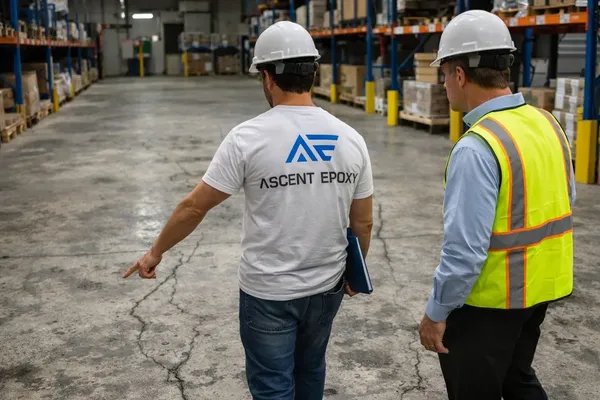
Walk the Facility & Read the Slab
~Half dayWe walk every zone, moisture-test the slab in multiple spots — paying close attention to ground-level and previously-flooded areas — log the chemicals each room sees, map forklift and foot traffic, and note existing cracks and joint movement. Book yours free.
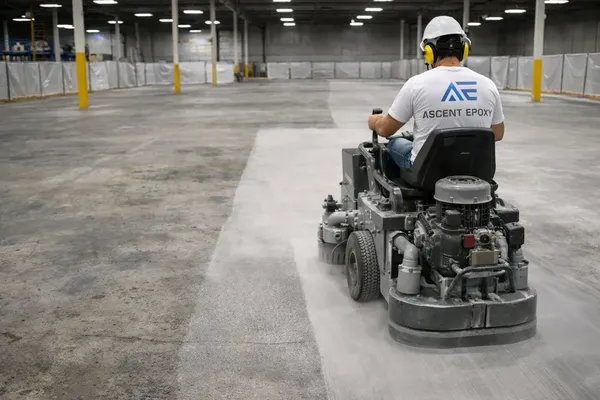
Grind, Blast & Repair
4–8 hrsDiamond grinding and shot blasting open up the full surface for a mechanical bond — no acid-etch shortcuts. Expansion joints, shrink-swell cracks, and spalled sections get cut out and rebuilt first, because on moving clay-soil slabs an unrepaired joint is the seam a coating tears along.
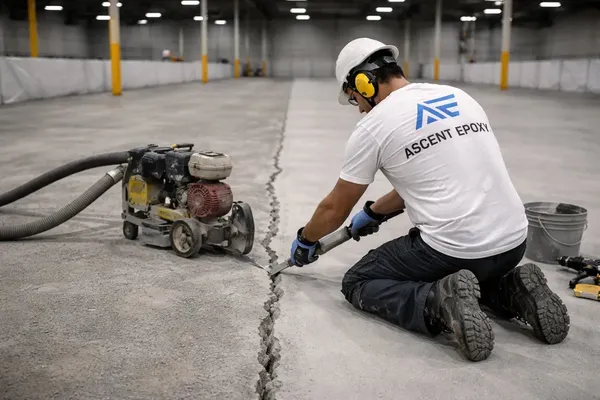
Lock Down the Moisture
2–4 hrsThis is the step that separates a floor that lasts from one that bubbles by next summer. Industrial primer bonds concrete to coating; where our testing flags a wet slab — the rule rather than the exception this close to the river — we add a vapor-barrier layer rated to hold back the moisture drive before the build coats go on.
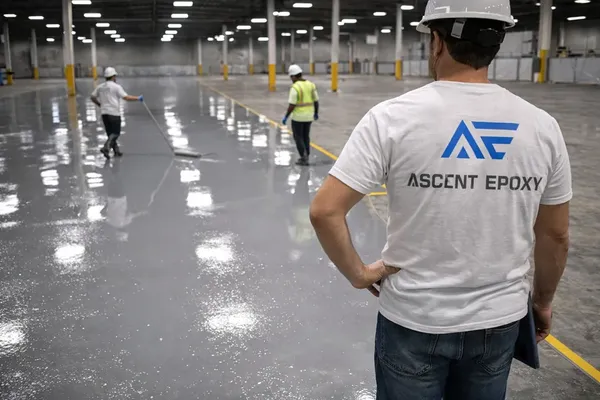
Build the System for the Room
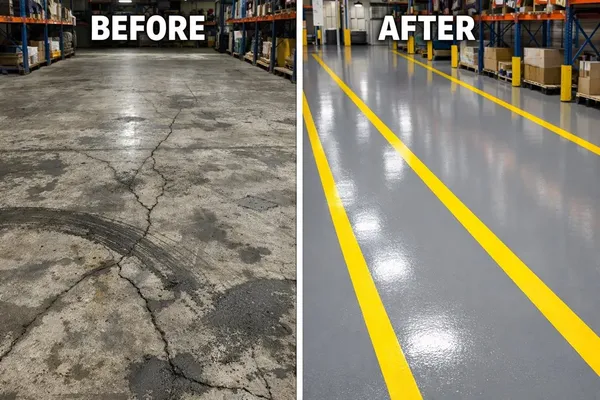
1–3 daysCoats go down to spec for that space — chemical-resistant for process areas, high-build impact coats for warehouse aisles. Striping, color-coded lanes, and anti-slip aggregate are worked in here, not added later.
Cure, Verify & Hand Off
3–7 daysCure happens under watched temperature and humidity — important in a climate that can swing the air on you mid-job. We check hardness, adhesion, and chemical resistance before you put the room back to work, then leave your crew a maintenance plan matched to your coating and chemicals.
Step 1 — the walk-through — is free.
We come read your slab, talk through the chemicals and loads, and show you finish samples on site. No obligation.
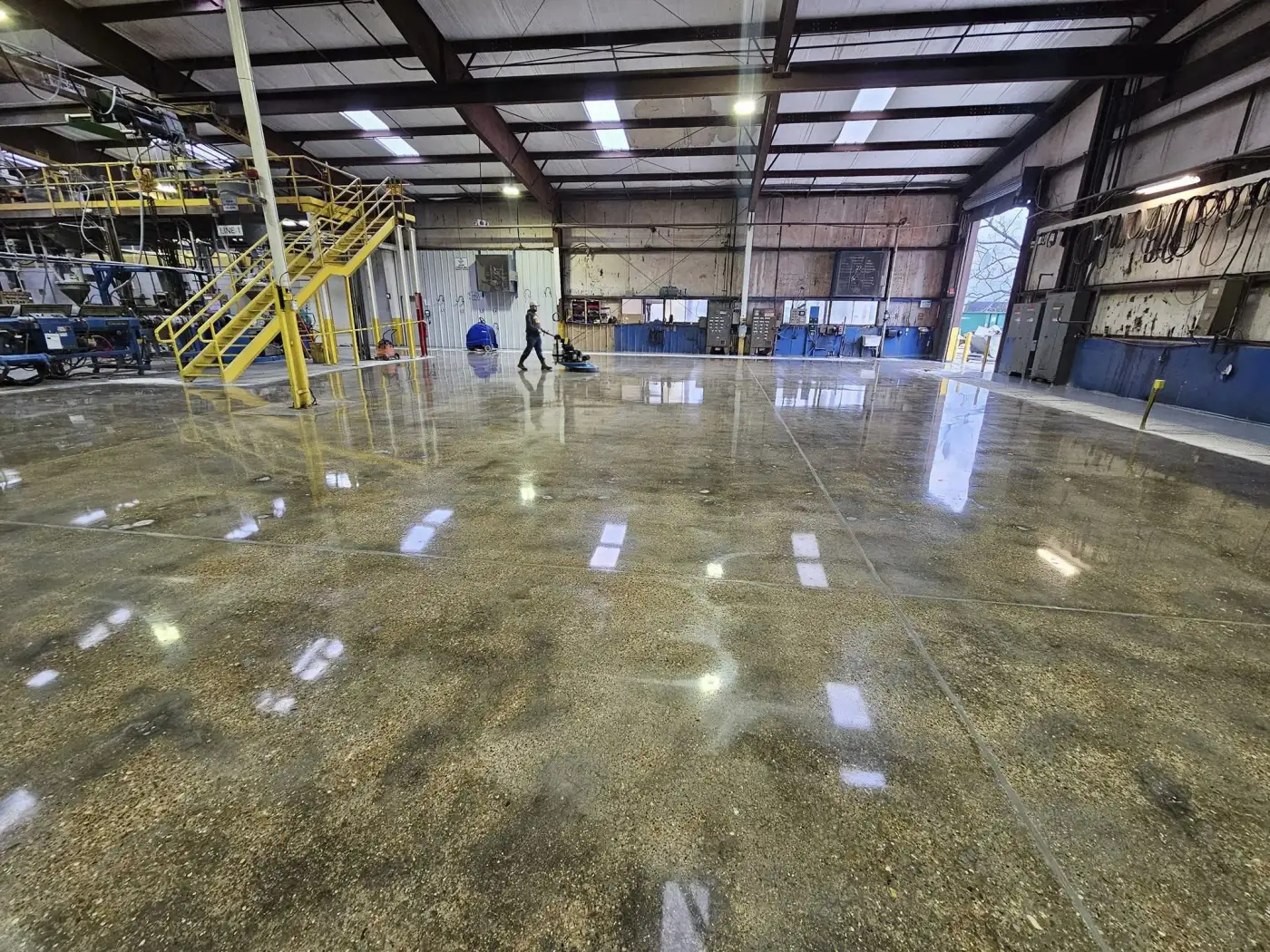
Floors Like the Ones We Install Around the Capital Region
Industrial floors like the ones we install across East Baton Rouge, Ascension, and Livingston parishes.
The Systems Baton Rouge Plants Ask For Most
We match the chemistry and build to the room. Here are the workhorses behind most Capital Region industrial jobs.
Warehouse Floor Coatings
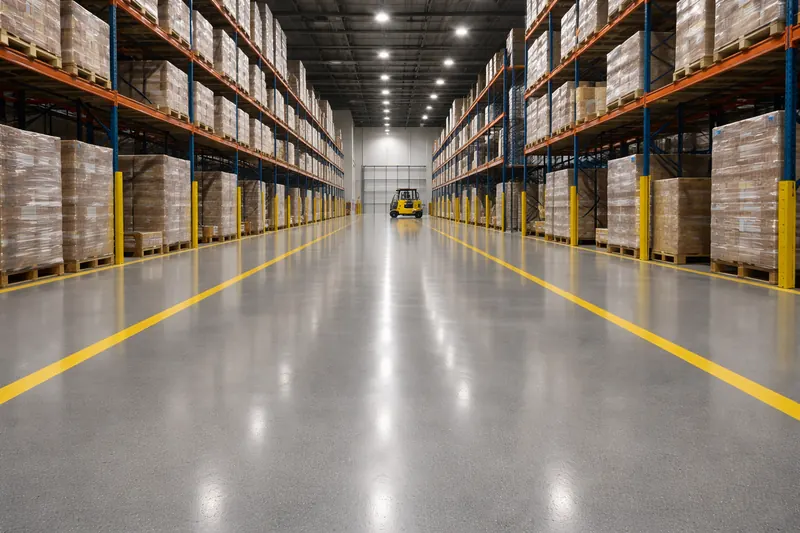
A warehouse floor lives a hard life: forklifts pivoting on the same few square feet, pallet jacks dragging steel across the surface, racking legs driving thousands of pounds into tiny contact points. Left bare, concrete in our humidity dusts, surface-cracks, and crumbles at the joints faster than a facility manager from up north would expect — moisture from below works against it the whole time.
Our warehouse systems lay a high-build epoxy under an abrasion-resistant topcoat sized for forklift wheels. Aisle striping, pedestrian lanes, and loading-dock color codes go in as part of the build. For distribution centers feeding the Port of Greater Baton Rouge and the I-10/I-12 freight runs, we phase the install dock-by-dock or bay-by-bay so trucks keep moving while we coat.
Secondary Containment Areas
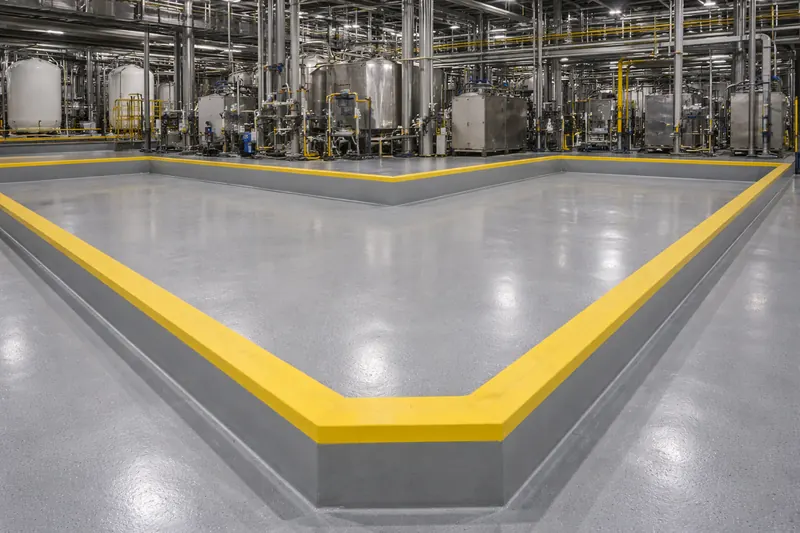
Anywhere hazardous chemicals, fuels, or solvents are stored, the floor has a second job: catch what leaks before it reaches the ground or a storm drain. Along a river corridor that drains straight to the Mississippi, that's not paperwork — Louisiana's DEQ along with EPA and OSHA rules hold these areas to a real standard, and a failed containment floor is a reportable problem.
We pour chemical-resistant containment coatings with integrated curbing and berms that turn a slab into a sealed basin. Built to hold 110% of the largest vessel's volume per state and federal requirements, the system stands up to acids, bases, fuels, and organic solvents — and we tie it back to the moisture and joint work below, because a containment floor that cracks at a joint isn't containing anything.
Rated 5.0★ by Capital Region Clients
Real reviews from Baton Rouge-area customers — verified on Google.
"Solid work, awesome floors."
"They did a metallic epoxy in my showroom. Looks spectacular and stands up to daily use. Very impressed."
"Exactly what I wanted, beautiful and functional."
Questions Baton Rouge Plant Managers Ask Us
Straight answers on industrial epoxy flooring for Capital Region facilities.
We install industrial epoxy flooring in a wide range of facilities across the Baton Rouge metro area, including:
- Warehouses and distribution centers
- Manufacturing plants
- Chemical processing facilities
- Food and beverage processing plants
- Maintenance bays and service shops
- Control rooms and clean environments
Our systems are engineered to handle the specific demands of each facility type, from chemical resistance in processing plants to impact resistance in high-traffic warehouses.
Baton Rouge's average 74% humidity is critical for large industrial slabs. Moisture trapped beneath the coating causes delamination and peeling, and on expansive warehouse floors, even small moisture variations can affect thousands of square feet.
We perform comprehensive moisture testing across the entire slab using calcium chloride and relative humidity probe methods. When readings are elevated, we apply moisture-mitigating primers and vapor barrier coatings before the epoxy system goes down. We also schedule installation windows around optimal humidity conditions to ensure a lasting bond.
Yes. Our industrial epoxy systems are formulated with chemical-resistant resins that withstand exposure to a wide range of substances, including acids, alkalis, solvents, petroleum products, oils, and fuels.
We offer various chemical resistance ratings depending on the specific chemicals present in your facility. Standard epoxy handles oil, grease, and mild chemicals.
Yes. We install OSHA-compliant safety line marking as part of our industrial epoxy flooring systems. This includes:
- Pedestrian walkways
- Forklift traffic lanes
- Hazard zones and restricted areas
- Equipment placement boundaries
- Emergency exit paths
- Color-coded area designations
All markings are applied with durable epoxy paint that bonds directly to the floor system and withstands heavy daily traffic without fading or peeling.
Industrial epoxy installation typically takes 3 to 7 days depending on the facility size, condition of the existing concrete slab, and complexity of the coating system required.
For larger facilities, we offer phased installation that allows you to keep portions of your operation running while we work on other sections. This minimizes downtime and keeps your production schedule on track. We provide a detailed project timeline during the estimate phase so you can plan around the installation.
Spec your facility floor in 60 seconds.
Choose square footage, finish, and color, and see a real preview plus a Baton Rouge-area price range before you ever pick up the phone.
Open Floor Studio →