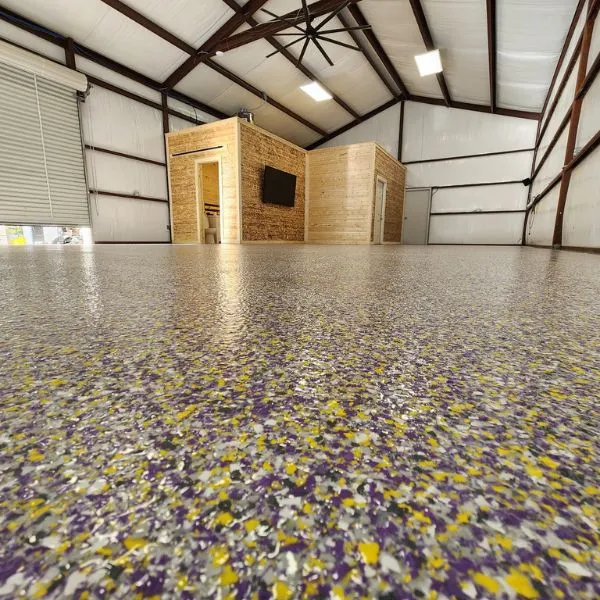
A properly installed residential epoxy floor in Baton Rouge lasts 10 to 20 years, a commercial floor lasts 5 to 10 years under heavy use, and a cheap or DIY job poured over a damp slab can fail in 1 to 3 years.
That spread is wide for a reason. Epoxy is not a single product with a fixed shelf life; it is a coating system, and how long it lasts depends almost entirely on what goes underneath it and what goes over it. The same can of resin can deliver two decades of service or peel up in a single Louisiana summer, and the difference is rarely the epoxy itself. It is the slab preparation, the moisture control, the topcoat, and the day-to-day care that follow.
This guide breaks down realistic lifespans by use and by coating system, explains what shortens epoxy life in our humid Gulf Coast climate, and walks through how to push a floor past its expected service life. If you would rather talk it through, call us at (337) 243-3062 for a free assessment.
Typical Epoxy Floor Lifespan by Use
The simplest way to think about epoxy lifespan is the three broad outcomes we see again and again in the Baton Rouge market, each tied to a level of traffic and installation quality.
Residential floors: 10 to 20 years. A garage, flex room, patio, or interior space in a typical Baton Rouge home sees foot traffic, the occasional vehicle, dropped tools, and ordinary spills, a relatively gentle environment for epoxy. When the slab is properly ground, moisture-tested, and finished with a UV-stable topcoat, these floors comfortably reach 10 to 20 years, and many last longer with a single mid-life recoat.
Commercial floors: 5 to 10 years. A restaurant kitchen, retail showroom, auto shop, or warehouse aisle is a far harsher world. Constant foot traffic, rolling carts, pallet jacks, chemical exposure, and daily wet cleaning all accelerate wear. A commercial-grade system still performs for 5 to 10 years, but the topcoat takes the abuse and needs renewal sooner. The base coat underneath, if installed correctly, often outlives several topcoats.
Cheap or DIY jobs: 1 to 3 years. A big-box kit rolled onto an unground, untested slab, with no vapor barrier and no real topcoat, simply cannot survive Baton Rouge conditions. These floors peel, bubble, or yellow within one to three years, and the failure is almost always blamed on the epoxy when the real culprit was the shortcut. Redoing a failed floor usually costs more than a professional install would have. The flat "epoxy lasts 10 to 20 years" quoted online is only true for the top tier; where your floor lands inside that range is decided before the first coat goes down.
Lifespan by Coating System
Not all epoxy floors are the same system, and the system you choose directly affects how long the floor lasts. The table below summarizes realistic lifespans for the main options we install in the Baton Rouge area, each assuming a correct install on a properly prepared slab.
| System | Typical Lifespan | Notes |
|---|---|---|
| DIY / Big-Box Kit | 1–3 years | Thin single coat, no diamond grind, no vapor barrier. First to fail in our humidity. |
| Solid Color Epoxy | 5–10 years | Durable for utility spaces; shows tire marks and wear sooner without a topcoat. |
| Flake Epoxy + Polyaspartic Topcoat | 15–20+ years | The Baton Rouge workhorse. UV-stable topcoat resists yellowing and hides wear. |
| Quartz Broadcast | 15–20 years | Heavy-duty, anti-slip. Common in commercial kitchens and high-traffic floors. |
| Metallic Epoxy | 10–15 years | Premium decorative finish; needs a quality topcoat to protect the look long term. |
A few patterns stand out. The systems that last longest share two traits: a thick, multi-coat build and a sacrificial topcoat that takes the wear so the colored layer underneath stays protected. Flake epoxy with a polyaspartic topcoat is the most popular residential choice in Baton Rouge precisely because that topcoat resists yellowing and shrugs off hot tires, two of the biggest threats to a garage floor here. The DIY kit, by contrast, is the only line in the table without real surface preparation or a dedicated wear layer, which is exactly why it sits at the bottom.
Quartz broadcast systems cost more up front but deliver the longest service in demanding settings, a better value over the life of the floor than a cheaper system replaced twice. For how polyaspartic's cure-and-wear characteristics compare, our guide on epoxy versus polyaspartic in Baton Rouge goes deeper.
What Shortens Epoxy Life in Baton Rouge
Our climate is the reason a floor that lasts 20 years in a dry state might last 3 in Baton Rouge if installed the same way. The leading causes of shortened epoxy life here mostly tie back to Gulf Coast moisture and heat.
Moisture Vapor Through the Slab
This is the number one floor-killer in the Baton Rouge area. The high water table across East Baton Rouge, Ascension, and Livingston parishes pushes moisture vapor up through slab-on-grade concrete. When that vapor reaches the underside of an epoxy coating, hydrostatic pressure forces it to lift, bubble, and delaminate, sometimes within months, and slabs in homes touched by past flooding are especially prone to retaining moisture. The only defense is a calcium chloride or relative-humidity probe test before installation and a vapor barrier when the numbers come back high.
High Humidity and Amine Blush at Install
Epoxy cures through a chemical reaction sensitive to the surrounding air. When ambient humidity is high during application, which is most of the year here, the curing surface can develop amine blush, a greasy or hazy film that compromises adhesion between coats, and a floor installed on a muggy July afternoon without humidity control can lose its bond before it ever sees traffic. Reputable installers schedule around the weather, run climate control inside the workspace, and time coats to the manufacturer's temperature and humidity window.
UV and Heat Yellowing
Standard epoxy resin is not UV-stable. Exposed to direct sunlight through an open garage door or a row of windows, it ambers and yellows over time, and the intense South Louisiana sun speeds that up. Yellowing does not weaken the floor structurally, but it ages the appearance fast and is one of the most common reasons homeowners think a floor has "worn out." A UV-stable polyaspartic or aliphatic topcoat prevents it, which is why we specify one on every garage and sun-exposed install.
Poor Surface Preparation
The bond between epoxy and concrete is mechanical, not magical. It depends on a clean, open surface profile created by diamond grinding or shot blasting. Many failed floors were prepped with an acid etch instead, a shortcut that does not open the pore structure reliably, especially on the dense, troweled slabs common in Baton Rouge garages. Without a proper grind, the coating has nothing to grip and peels at the first stress. Preparation is invisible in the finished floor yet it is the single biggest predictor of how long that floor lasts.
Heavy Abrasion and Hot-Tire Pickup
Dragging heavy equipment, grit ground underfoot, and the heat of vehicle tires all attack the surface. Hot-tire pickup is a particular issue in Baton Rouge garages: a tire heated on summer asphalt softens a weak coating and lifts it when the car parks. A quality topcoat and a properly cured system resist this, while a thin or under-cured floor surrenders to it. This is exactly the wear the topcoat is designed to absorb, which is why renewing it matters so much for longevity.
Harsh Chemicals
Battery acid, brake fluid, certain solvents, and aggressive cleaners can etch or soften epoxy if left to sit, and garages and commercial spaces see these regularly. A chemical-resistant system handles ordinary exposure fine, but prompt cleanup is still the right habit, and harsh stripping cleaners should never be used for routine maintenance. In food-service and industrial settings, matching the system's chemical resistance to the actual exposure is part of getting full service life.
What Extends Epoxy Floor Life
The good news is that nearly every floor-killer has a direct countermeasure. A floor built and maintained with these in mind reliably reaches the top of its range, and often beyond.
- Proper moisture testing and a vapor barrier. Testing the slab before the first coat and installing a moisture-mitigation layer when the readings call for it neutralizes the single biggest cause of premature failure here.
- Diamond grinding the slab. A mechanical grind, not an acid etch, gives the coating the surface profile it needs to bond for the long haul.
- A UV-stable polyaspartic topcoat. The layer that resists yellowing, shrugs off hot tires, and takes the abrasion so the colored base coat stays protected.
- Routine maintenance. Sweeping grit and the occasional gentle wet clean keep abrasive particles from grinding into the finish like sandpaper.
- Mats under tires. Pads under vehicle tires prevent hot-tire pickup, the most common cause of cosmetic damage in home garages here.
- Prompt spill cleanup. Wiping up oil, chemicals, and standing water before they sit protects both the finish and the bond.
- Periodic recoat. Refreshing the topcoat every several years, before it wears through to the base, is the most cost-effective way to add a decade or more of life.
None of these require special expertise from the homeowner. The two that depend on the installer, moisture testing and diamond grinding, are exactly the steps a bargain quote skips, which is why we treat them as non-negotiable on every Baton Rouge project.
Want a Floor That Lasts in Louisiana?
The difference between a 3-year floor and a 20-year floor is in the prep. Call us for a free assessment of your slab and an honest plan built for our climate.
Residential vs. Commercial: Why Lifespans Differ
The gap between a residential floor's 10-to-20-year range and a commercial floor's 5-to-10-year range is not about quality; a commercial system is often built tougher than a home system. The gap is about how hard each floor is worked and how that work is spec'd into the coating.
A home garage might see two vehicles, a few hundred footsteps a day, and the occasional dropped wrench. A commercial floor of the same size can see hundreds of people, rolling carts and pallet jacks, forklift wheels, daily wet mopping with chemicals, and in a restaurant kitchen, constant grease and hot water. Every one of those is an accelerant. A topcoat that would last 15 years in a quiet garage might wear visibly in 3 under a forklift route. The base coat survives, but the protective layer above it is consumed far faster.
That is why systems are spec'd differently from the start. A residential project typically gets a flake epoxy floor with a robust polyaspartic topcoat, optimized for appearance and a long, low-maintenance life. A commercial project leans toward quartz broadcast systems, thicker overall, with anti-slip aggregate and chemical resistance matched to the business, and we plan topcoat renewal as scheduled maintenance rather than an unexpected failure. A Baton Rouge restaurant, an auto shop, and a warehouse each get a different build, because each wears its floor differently.
Signs Your Epoxy Floor Needs Attention
Epoxy floors rarely fail all at once; they give warning signs. Reading them correctly is the difference between a quick, inexpensive recoat and a full tear-out-and-replace. Here is what to watch for and what each one is telling you.
- Dullness and loss of gloss. The most common and least alarming sign. A floor that has lost its shine usually just has a worn topcoat, making it the ideal moment to recoat before wear reaches the base.
- Fine micro-scratches. A network of light scratches points to grit abrasion and a thinning wear layer. Caught early, a topcoat renewal restores it; left alone, the scratches deepen into the color coat.
- Yellowing or ambering. A cosmetic, not structural, problem caused by UV exposure on a non-UV-stable coating. It signals the floor needs a UV-stable topcoat and is fixable with a recoat in most cases.
- Hot-tire pickup. Patches where the coating has lifted under a parked tire indicate a thin coat, an under-cured system, or a bonding weakness. Small areas can be repaired; widespread pickup suggests a deeper adhesion issue.
- Edge peeling or lifting. Coating pulling away at edges, expansion joints, or corners is usually a bond or moisture problem rather than simple wear, and warrants a professional look before it spreads.
- Bubbling or blistering. The most serious sign. Bubbles under the coating almost always mean moisture vapor is pushing up through the slab, a preparation or moisture-mitigation failure that typically calls for grinding the affected area back to concrete, correcting the moisture, and recoating, not just a topcoat refresh.
The practical rule is simple: surface symptoms like dullness, light scratches, and yellowing mean it is time to recoat, an affordable maintenance step. Adhesion symptoms like peeling, lifting, and bubbling mean the bond or the slab moisture must be addressed before any new coating goes down. When you are unsure which camp a floor is in, an in-person assessment settles it quickly, and catching a recoat in time is far cheaper than a replacement.
Frequently Asked Questions
How long does an epoxy garage floor last?
A professionally installed epoxy garage floor in Baton Rouge typically lasts 10 to 20 years. A flake epoxy system with a UV-stable polyaspartic topcoat, applied over a diamond-ground and moisture-tested slab, sits at the top of that range. Garages see hot tires and chemical spills, so the topcoat does the heavy lifting; when it eventually dulls, a single recoat restores the surface without a full teardown.
Why do some epoxy floors fail in a few years?
Early failure almost always traces back to preparation, not the epoxy itself. The most common causes are skipped moisture testing on a damp Baton Rouge slab, an acid-etch instead of a proper diamond grind, a single thin DIY coat, and no UV-stable topcoat. Any one of these can cause peeling, bubbling, or yellowing within one to three years. A correctly prepped and coated floor does not fail this fast.
Does humidity shorten epoxy life in Baton Rouge?
Humidity does not shorten the life of a properly installed floor, but it punishes shortcuts. Louisiana's roughly 74 percent average relative humidity and high water table push moisture vapor up through slab-on-grade concrete, and high ambient humidity at install can cause amine blush that ruins adhesion. The fix is moisture testing, a vapor barrier when the slab needs one, and curing inside the manufacturer's temperature and humidity window. Done right, a Baton Rouge floor lasts as long as one in a dry climate.
Can I extend my epoxy floor's life?
Yes, and most of it is easy. Sweep grit regularly because it acts like sandpaper, wipe up oil and chemical spills promptly, place mats under vehicle tires to prevent hot-tire pickup, and avoid dragging sharp metal across the surface. The single biggest extender is a periodic recoat of the topcoat every several years, which refreshes the wear layer before damage reaches the colored base coat and can push a floor's usable life well past 20 years.
How often should I recoat an epoxy floor?
Most residential floors in Baton Rouge benefit from a fresh topcoat every 5 to 10 years, while busy commercial floors may need one every 2 to 5 years depending on traffic. The trigger is wear, not the calendar: when the gloss dulls noticeably, fine scratches accumulate, or the surface starts to feel rough underfoot, it is time to recoat. Recoating the topcoat before it wears through to the base coat is far cheaper than a full replacement.
Does epoxy last longer than concrete paint?
Yes, by a wide margin. Concrete or garage floor paint is a thin surface film that typically peels and wears within one to three years, especially under hot tires and Baton Rouge humidity. A true multi-coat epoxy system bonds into the ground concrete profile and is many times thicker, so it lasts 10 to 20 years residentially. Paint is a cosmetic refresh; epoxy is a long-term floor system.
Get a Floor Built to Last in Baton Rouge
The honest answer to "how long does an epoxy floor last" is that it depends almost entirely on the install. A floor poured over a tested, diamond-ground slab and sealed with a UV-stable topcoat will serve your Baton Rouge home for 10 to 20 years and your business for the better part of a decade, while one that skips those steps may not see its third summer. The number on the brochure is real, but only the right preparation earns it.
At Ascent Epoxy Baton Rouge, every project starts with an in-person slab assessment, on-site moisture testing, and a system spec'd for how you actually use the space, so you get the full lifespan, not a fraction of it. We serve Baton Rouge, Prairieville, Denham Springs, Gonzales, Central, Baker, Zachary, Walker, and Port Allen. Call (337) 243-3062 or request a free quote online.
Related Articles
Epoxy Flooring Cost in Baton Rouge: What Sets Your Price (2026)
What drives the price of a Baton Rouge epoxy floor up or down, project by project.
How to Maintain Your Epoxy Floor in Baton Rouge
Simple routines that keep your floor looking new and extend its service life for years.
Louisiana Humidity and Epoxy Flooring: What You Need to Know
How Baton Rouge's climate affects epoxy installation, curing, and long-term performance.